
Riverbank land use change
Reconsidering and changing the use of a riverbank can be an excellent solution when water levels change due to dam building, crops are gnawed on, or a lodge or burrow is in an unwanted location, causing further burrowing or foraging impacts.
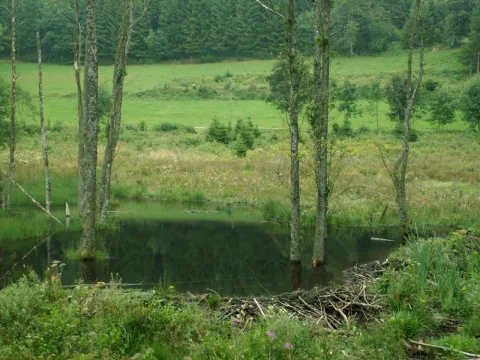
© S. Vreugdenhil
Page content
To prevent damage caused by beaver activity, the land use of a bank can be reconsidered and assigned a different function. For example, from agricultural use to a nature function.
Nature strip
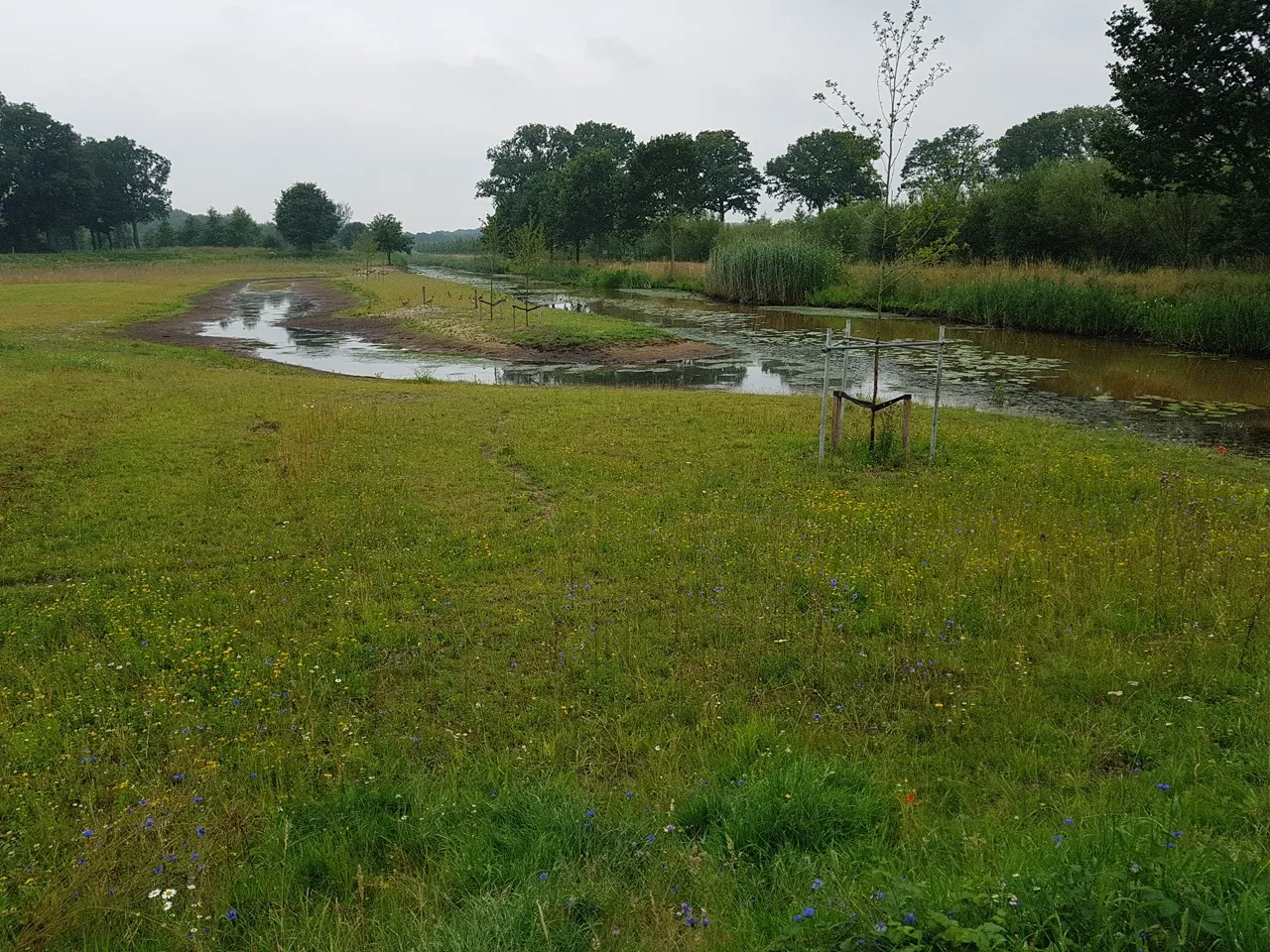
A nature strip is a section of bank that is taken out of agricultural use and converted to natural vegetation (Figure 1). This method can reduce risks or damage caused by beaver activity and dam construction. The layout and function of the nature strip may differ depending on the situation, such as dam building or foraging impact. Below are recommended applications and design options.
Near dam construction
Dams can raise water levels and cause waterlogging in adjacent agricultural land. A nature strip helps buffer this effect. The required width of the strip along the bank depends on the slope of the watercourse and the surrounding topography. Where the watercourse lies deep in the landscape, the strip can be narrower than in flat terrain.
Near burrow or lodge
Beaver burrows and lodges in banks can create safety risks for people, vehicles, and equipment. In these cases, converting the bank to a nature strip is advisable.
Recommended measures:
- Establish a strip 5–10 metres wide along the bank.
- Lower the ground level between the nature strip and farmland to a maximum of 30 cm above the average groundwater level. Beavers will not continue burrowing, as this ensures the tunnel roof will collapse.
- Optionally, install a dry ditch as an extra barrier, which:
- must not carry water year-round.
- must not be connected to flowing water.
(Otherwise, beavers may build a dam and still dig under the field.)
- Use the excavated soil to raise the bank strip and create steep banks. This encourages beavers to burrow in less critical areas.
Near foraging area
Beavers may feed on crops close to the water. A nature strip can reduce crop loss by increasing the distance between the water and valuable crops. A strip 10 to 20 metres wide along the bank is recommended, as beavers rarely forage beyond this range.
Within 30 metres of the bank, it is best to avoid growing crops that are particularly attractive to beavers, such as maize, beets, and carrots. Grain is less attractive to beavers and generally results in less foraging damage.
Foraging strip
A different solution would be to intentionally cultivate an agricultural crop that is attractive to beavers along a specific part of the shoreline. This would attract the beavers to this spot, and divert them from more vulnerable areas. It is recommended to investigate certain crop varieties that may be particularly appealing to beavers.
Scarecrows
Scarecrows are sometimes used to keep beavers away from crops. However, this solution is potentially only effective for a short time, as the beavers quickly become accustomed to the scarecrow and will resume forage on the valuable crops.