
Protection status and legislation
Across most of Europe the Eurasian beaver is legally protected against killing, disturbance, and habitat destruction.
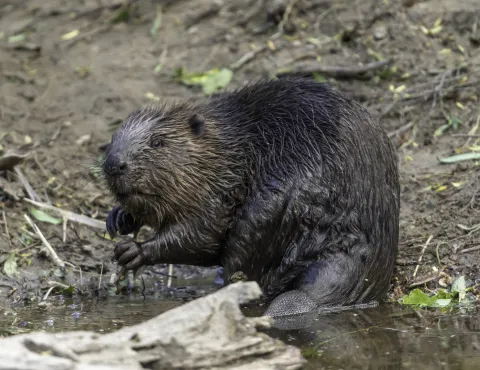
© Beaver Trust
Page content
The Eurasian beaver (Castor fiber) was once widespread across Europe and parts of Asia. Since the late 19th century, legal protection and reintroduction efforts have led to a strong recovery. More information on the distribution of the Eurasian beaver can be found here.
- IUCN Red List (2023): Least Concern
- Population trend: Increasing in Europe
- Ecological role: Wetland restoration, increased biodiversity, water retention
Legislation overview
The Eurasian beaver is legally protected across much of its range. However, the level and type of protection vary between international, European, national, and local contexts. On European level beavers are protected under the Bern Convention (Appendix III) and the EU Habitats and Species Directive (Annex II, IV, or V).
For correct information and details on national or regional legislation, please refer to local government or conservation authority websites, such as national environmental ministries, protected area authorities, and EU country-specific Natura 2000 websites.
| Framework | Legal strength | Scope | Protection type |
| IUCN Red List | Scientific, not legal | Global | Conservation status assessment |
| Bern Convention | Moderate | Europe + neighbours | Regulated management |
| EU Habitat Directive | Strong (EU law) | EU member states | Strict protection & habitat conservation |
The Bern Convention sets a minimum standard across a broader group of countries, including non-EU states. Some EU laws, like the Habitats Directive, were inspired by or aligned with the Bern Convention—but go further in scope and enforcement. In EU countries, the Habitats Directive takes precedence and provides stricter protection.
At European level and beyond
Outside the European Union, Eurasian beaver protection varies significantly:
- Strict protection from killing, disturbance, and habitat damage under national law (e.g., Switzerland, England, Scotland)
- Moderate protection in countries with reintroductions or Bern Convention obligations (e.g., Wales, Serbia).
- Game species status in countries with abundant populations (e.g., Russia, Belarus).
- Extinct or absent in much of the Middle East and Central Asia, with limited or no legal recognition.
Bern Convention
The Eurasian beaver is listed in Appendix III of the Bern Convention on the Conservation of European Wildlife and Natural Habitats, which includes protected fauna species that are not under strict protection like those in Appendix II of the EU Habitat directive. Member states must ensure that any exploitation (e.g. hunting, capture, or trade) of these species is regulated to keep populations viable. Member states include almost all members of the Council of Europe, a number of African countries and the European Union.
Within the European Union
EU Habitats Directive (Council Directive 92/43/EEC) aims to protect species and habitat types to ensure they are maintained, restored, and recovered to a favourable conservation status within the EU. There are different annexes (lists) that provide varying levels of protection and rules for species and habitats.
The Eurasian beaver, except for some population, is listed in Annex II and IV . The Baltic, Polish, Finnish and Swedish beaver populations are listed in Annex V.
| EU Habitat Directive | Protection | Details |
| Annex II | Requires designation of Special Areas of Conservation (SACs) | except the Estonian, Latvian, Lithuanian, Finnish, and Swedish populations |
| Annex IV | Strict protection from killing, disturbance, and habitat protection | except the Estonian, Latvian, Lithuanian, Polish, Finnish, and Swedish populations |
| Annex V | Species whose taking in the wild may be subject to management | Only Finnish, Swedish, Latvian, Lithuanian, Estonian, and Polish populations |
National and local protection
Protection varies by country, within the EU, and even regionally within countries:
- In some countries, beavers are strictly protected from killing, disturbance, and habitat damage (e.g. England, Germany, Sweden).
- In others, regulated management or licensed control is allowed to address human-wildlife conflicts (e.g. Norway, Finland, parts of Central and Eastern Europe).
- Reintroduction or population expansion often includes local agreements with landowners or land managers, water managers, and municipalities.
Please refer to your local government and conservation authority for correct and detailed information on laws and regulations in your region.